
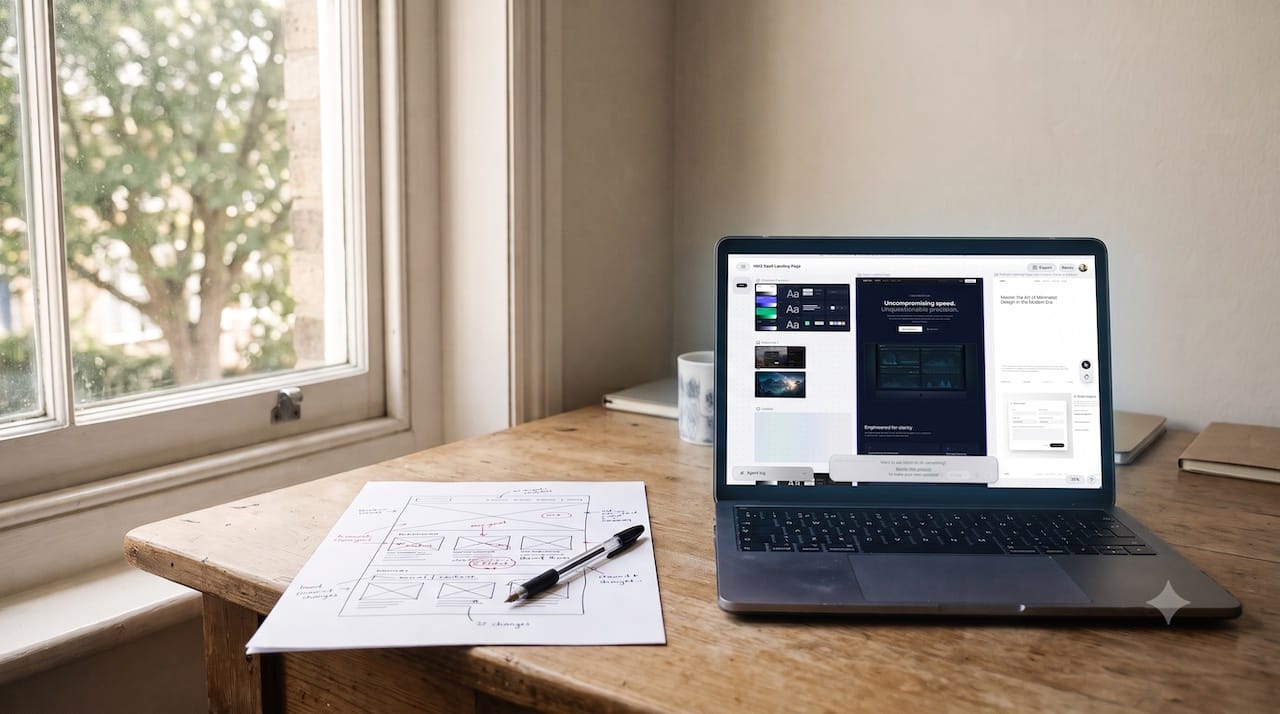
Yes, up to a point. Give an AI design tool a sentence about your business and it will hand back a competent, plausible-looking website layout in seconds. What it will not do is work out what your website is for, who it needs to convince, or which of the ten layouts it just produced is the one that will bring you work. That gap is small if you only want a picture of a website. It's the whole job if you want an effective website for your business.
Much of the writing on this subject is oddly binary. Either AI has made professional design obsolete, or AI slop will never match a human touch. Neither is correct, it's black or white thinking, the more interesting and useful story is in the grey.
What the falling design software share prices do and do not tell you
Anyone following tech company share prices will tell you that the SaaS market in general, including companies like Adobe and Figma, have seen their share prices plummet as AI models have displayed more and more capability. Figma's share price fell by around half over the first six months of 2026, according to S&P Global Market Intelligence data, despite the company reporting strong results in the same period. Its steepest single drop came in April, when Anthropic launched Claude Design, a tool that produces complete designs from a text prompt. Adobe came under similar pressure.
However, the share price is not a measurement of whether AI can design well, its an indication of what investors think will happen to software subscriptions. Those are separate questions, and the market has only voted on the second one. What was being repriced was the value of selling a monthly seat to a professional designer, not the quality of what designers do.
Web design is our business, and we use these tools every day, including LLM tools from Anthropic, Google, and OpenAI. This is not a piece arguing that AI cannot design. It's a piece about which parts of the work it has taken over, and which parts it has not touched.
What are AI design tools good at?
They are very good at producing a large number of reasonable options quickly. Ask Claude Design, Google Stitch, Figma Make, or the AI features now built into Adobe and Canva for a booking page, and you will have several credible versions in the time it used to take to sketch one. That changes what is worth trying.
They are also good at conventions. These tools have absorbed an enormous amount of the web, so they know where navigation usually sits, what a pricing table looks like, and how a testimonial block is normally arranged. For anything conventional, that is a real head start rather than a compromise.
Stitch, which Google built on its acquisition of Galileo AI and rebuilt substantially in March 2026, will wire multiple screens into a clickable prototype and export to Figma or as HTML and CSS. The tools are useful for grinding work too. One designer publicly described using Claude alongside Figma's MCP server to audit typography across a large component library and consolidate the styles in a single morning, which is the kind of task that previously got postponed indefinitely because nobody could justify the hours.
The honest summary is that the first sixty per cent of a design job has become dramatically cheaper. That is real progress and it's not going to reverse.
Where do AI design tools fall short?
The remaining forty per cent, which is the part involving judgement, context, and consequences. The designers using these tools most heavily are the clearest about this.
In the AI in Design 2026 survey of over 900 designers by Designer Fund and Foundation Capital, 62% named inconsistent or unreliable output quality as their biggest challenge, with lack of control over the output and lack of product or brand context following behind. Worth noting that Anthropic was a partner on that survey, and that its respondents skew towards in-house product teams rather than studios, so read it as a picture of one part of the industry. Even so, the pattern is consistent with what reviewers of individual tools report: layouts that look right until you interrogate them, variations that all resemble one another, and designs that need meaningful reworking before they can ship.
Then there is the quieter problem, which is that a design can be wrong in ways a screenshot cannot show. Exported layouts often look responsive without being responsive, holding together at the size they were generated for and falling apart at the others. Structural work, spacing systems, and component consistency tend to need rebuilding by hand rather than tidying.
Accessibility is the clearest evidence we have that this matters. WebAIM's 2026 survey of the top million home pages found an average of 56.1 detectable accessibility errors per page, up 10.1% on the previous year, with 95.9% of pages carrying a detectable failure against the Web Content Accessibility Guidelines. That reversed several years of slow improvement, and WebAIM attributes the change partly to rising page complexity and to automated or AI-assisted coding practices. The same six basic failures have topped that report for seven years running, and insufficient colour contrast alone appeared on 83.9% of pages. Automated scans catch only a fraction of real barriers, so the true figures are worse.
Nobody prompts a tool for a site that fails contrast requirements. It happens because nothing in the process was responsible for checking.
UI is not UX, and the gap between them is where the money sits
A user interface is the visible, clickable surface: the buttons, the type, the images, the layout. User experience is broader. The term was coined by Don Norman in the 1990s to cover every aspect of a person's dealings with a company and what it sells, from finding it in the first place through to using the thing repeatedly. Nielsen Norman Group illustrate the distinction with a film review site: the interface for finding a film can be flawless, and the experience will still be poor if the film someone came looking for is not in the database.
This is the crux of the commoditisation question. AI design agents work on the interface, because the interface is what a prompt can describe. A prompt cannot describe the things that decide whether a small business website works: that most enquiries arrive at half past seven in the evening from a phone, that customers want to know the callout area before they want to know anything else, that the last three jobs were lost because the quote form asked for information people did not have to hand.
A beautiful interface built on the wrong understanding of the customer is an expensive way to fail.
How professional designers are using these tools in their own work
Heavily, and not as a replacement for their own judgement. The same 2026 survey found 91% of designers using AI weekly, up from 54% a year earlier, with 75% using it daily and the average toolstack rising from three tools to seven. Half said they had shipped AI-generated code to production. Anyone claiming professionals are holding the line against these tools is not paying attention.
What has changed is the shape of the work. Designers in that report describe prototyping in code and then returning to Figma for precise finishing, treating it as an instrument for exact cuts rather than the place where the whole design lives. The generation is cheap; the deciding is not. Producing ten versions of a homepage is now trivial. Knowing which one to keep, and being able to say why the other nine are wrong for this particular business, is the part that took fifteen years to learn.
That is also the honest answer to whether a studio should use AI. We do, where it earns its keep. It has made exploration cheaper, made small custom tools worth building, and removed a category of tedious work that used to eat billable hours without improving anything.
Why a design made for you beats a design made for everyone
Because these models are trained on averages, and left to themselves they produce a very competent average. Unconstrained, they drift towards the same rounded cards, the same generous hero, and the same safe pairing of typefaces you have seen on a hundred sites this year. That is precisely the opposite of what makes a business recognisable as itself.
The comparison is with photography rather than with anything more dramatic. Phone cameras did not end professional photography. They ended the market for someone who could operate a camera competently. What survived, and in places grew, was direction: knowing what the shot needs to say, and for whom.
The same distinction applies here. A generated design cannot know that your best customers come by recommendation and arrive already half sold, so the site needs to confirm rather than persuade. It cannot know that your competitor undercuts you by twenty per cent and your entire case rests on explaining what they leave out. It cannot know which of your services is worth ten times the others. Those things come out of a conversation with you, and they change the design at a level no amount of prompting reaches.
What this means for your website
If you want to see what a layout might look like, use the tools. They are free or close to it, they are quick, and there is no sense paying anyone to produce a first sketch in 2026. Bring what you generate to the conversation. A clear reference of what you like is worth more than a vague brief.
What you should not do is assume the picture is the website. Between a generated screen and a site that loads quickly, works on the phone your customers hold, meets accessibility requirements, survives editing by whoever updates it next, and is set up so you can tell whether it's working, there is a substantial amount of work, and it is the work that determines whether the thing brings in enquiries. Modern tools, sensibly used, make that work faster. They donot remove it, and they leave nobody accountable for it.
If you are weighing up a generated design against a professionally designed website, the question to ask is not which looks better on the screen today. It's which one someone has thought through thoroughly, and will keep looking after once it's live.